Written by EDAL, crystal and award customization specialist at Marseilia Gifts
Choosing between laser engraving vs sandblasting is one of the first decisions you’ll make when ordering custom trophies, plaques, or crystal awards — and it affects how your award looks, how long it lasts, and how much it costs. If you’ve searched for “trophy engraving near me” and landed here, you’re probably comparing quotes and trying to work out which technique actually suits your event, your budget, and your material.
This guide breaks down both methods in plain terms: how each one works, where each one shines, what they cost to produce, and which one fits sports trophies, corporate crystal awards, glass plaques, and cup engraving. By the end, you’ll know exactly what to ask your supplier before you order.
What’s the Difference Between Laser Engraving and Sandblasting?
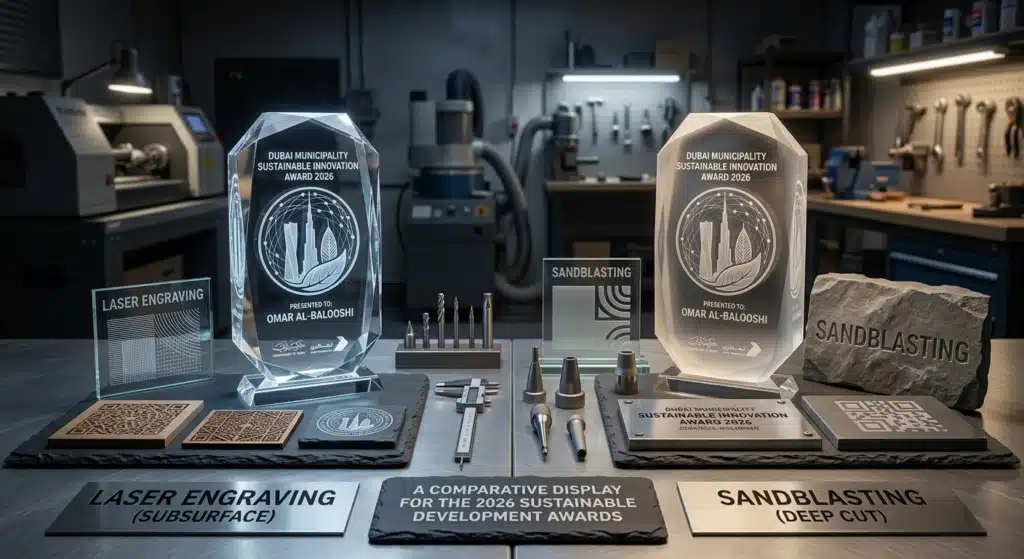
Laser engraving uses a focused laser beam to heat, melt, or vaporize a thin layer of the material’s surface, burning in text, logos, and fine detail with no physical contact. Sandblasting propels fine abrasive particles at high pressure through a stencil, physically cutting a frosted, textured design into the surface.
Laser engraving on glass etches designs by heating and melting the surface, allowing detailed and intricate patterns, and the process is relatively fast and cost-effective. Sandblasting, by contrast, is the most common engraving method used in the trophy shop industry, propelling abrasive material through a stencil to cut the design into the surface.
Both are legitimate, widely used techniques — the right choice depends on the material, the level of detail, the order quantity, and the finish you want.
How Each Method Works
Laser Engraving: Step by Step
- The design (logo, name, or text) is prepared in vector software.
- The award is placed in the laser bed and aligned.
- A CO2 or fiber laser traces the design, burning or vaporizing the surface with heat.
- The piece is cleaned — no masking or stencil removal needed.
Sandblasting: Step by Step
- A stencil (photoresist film) is cut or printed with the design and applied to the surface.
- Only the exposed areas are left uncovered.
- Abrasive media is blasted at high pressure onto the exposed surface, etching it.
- The stencil film is removed and the piece is cleaned to reveal the finished engraving.
Sandblasting generally involves more manual masking and cleanup, which is why it requires more skill, equipment, and time than running a laser — one reason many engraving shops don’t offer it in-house.
Laser Engraving vs Sandblasting: Side-by-Side Comparison
| Factor | Laser Engraving | Sandblasting |
|---|---|---|
| Best for | Metal, wood, acrylic, fine detail, logos, bulk orders | Glass, crystal, stone — bold text and deep frosted effects |
| Detail level | High precision — fine lines, small text, complex artwork | Strong for large text and bold graphics; less suited to fine detail |
| Finish on glass | Can appear less sharp on glass because heat affects clarity | Sandblasted marks generally come out sharper and clearer than laser-etched marks on glass |
| Speed | Very fast — a laser-etched glass piece can be ready in as little as a few minutes | Much slower — involves stencil fixture, blasting, and removal |
| Production cost | Lower setup and production cost, especially for bulk runs | Can cost significantly more depending on design intricacy |
| Repeatability | Design saved digitally; identical results every time | Depends on stencil reuse and operator consistency |
| Material risk | Some glass types may develop micro-cracks from heat | Requires careful handling — glass/crystal can chip during blasting |
| Typical use in awards | Metal plates, wooden plaques, acrylic awards, personalization | Glass plaques, crystal trophies, stone awards |
Laser Engraving: Pros and Cons
Pros
- Achieves fine details and complex designs that are difficult with other methods
- Faster turnaround, especially for bulk corporate or sports club orders
- Designs can be saved and reproduced consistently for repeat orders
- Works across multiple materials — metal, wood, acrylic, some crystal
Cons
- Marks on glass may not be as sharp or clear as sandblasted results
- Heat sensitivity can occasionally cause micro-cracking in certain glass types
- Less suited to very deep, tactile, frosted effects
Sandblasting: Pros and Cons
Pros
- Produces a smooth, high-contrast, tactile finish that many buyers associate with premium glass and crystal awards
- Excellent for bold lettering and large-format designs on glass plaques and cups
- A traditional, well-established technique for glass trophy engraving
Cons
- Slower and more labor-intensive — stencils must be applied, blasted, and removed by hand
- Higher cost, particularly for intricate or multi-color designs
- Less practical for very fine detail compared to laser
Which Method Suits Your Material?
Different award materials respond differently to each technique — this is one of the most common questions we field from corporate and event buyers.
- Metal trophies and plaques: Metal engraving typically needs stronger machines such as rotary engravers or fiber lasers, which can mark through hard metals like brass and aluminum. Laser is the practical default here.
- Wooden awards: Laser engraving is preferred for wood because it produces clean, detailed branding without splintering the surface.
- Glass plaques and cups: Glass engraving is mainly done by lasers because they are fast and gentle on fragile material, though sandblasting remains popular for a deeper, frosted look. Many trophy shops offer both and select based on the order.
- Crystal trophies and silver trophy cups: Laser engraving vaporizes microscopic layers of crystal to create detailed markings and is widely used for accurate, clean reproduction of corporate logos, while sandblasting produces a soft, frosted, more traditional appearance.
- Acrylic awards: Laser cutting and engraving work well together, allowing custom shapes and fine branding in one process.
Cost and Turnaround Considerations
Cost depends on material, design complexity, and order volume rather than the technique alone, but as a general rule:
- Laser engraving tends to be more cost-effective for bulk orders because setup is digital and repeatable, with no stencil cost per piece.
- Sandblasting takes considerably longer per piece since it involves stencil preparation, careful blasting, and cleanup, which is reflected in higher pricing for intricate designs.
- For a single premium crystal award, the extra time sandblasting takes is often worth it for the tactile, frosted finish some buyers prefer.
- For 50+ identical corporate awards or sports medals, laser engraving usually keeps both cost and lead time down.
Practical tip: if you’re ordering a mixed batch — for example, glass plaques for VIP winners and standard metal medals for participants — ask your supplier whether they can combine both techniques in one order, similar to how many glass award specialists choose the method per piece rather than forcing a single process across an entire batch.
Common Mistakes to Avoid When Choosing an Engraving Method
- Assuming one method is “better” in every case. The right choice depends on material and design, not a universal winner.
- Ignoring the material’s heat sensitivity. Certain glass types are more prone to micro-cracking under laser heat — ask your supplier which glass they use.
- Requesting fine, small-text detail on sandblasted glass. Sandblasting is stronger for bold designs; very small text can lose crispness.
- Not asking for a sample or proof. Especially for large corporate orders, a proof avoids costly reprints.
- Overlooking turnaround time for event deadlines. If your event date is fixed, factor in that sandblasting generally takes longer per piece.
Expert Tips for Buyers
- Bring a vector file (AI, EPS, or high-resolution PDF) of your logo — this improves precision regardless of the method used.
- For sports clubs ordering season-end trophies in bulk, laser engraving on metal or acrylic keeps unit costs and turnaround manageable.
- For a milestone corporate award or retirement gift, a sandblasted crystal or glass plaque often reads as more premium and personal.
- Ask whether the supplier engraves in-house — in-house engraving generally means faster proofing and fewer handling risks for fragile crystal.
- Always confirm engraving placement (front, back, base) before production, especially for two-sided glass plaques.
Frequently Asked Questions
Is laser engraving or sandblasting better for glass trophies? Both work well on glass. Laser engraving is faster and more cost-effective, especially for bulk orders, while sandblasting typically produces a deeper, more tactile frosted finish. The best choice depends on your design detail, budget, and timeline.
Which method is more durable? Both are permanent engraving methods and, when done correctly, resist fading or wearing off under normal handling. Durability issues (chipping, cracking) usually relate to material handling rather than the engraving method itself.
Can laser engraving be used on a silver trophy cup? Yes. Laser engraving is commonly used on metal trophy cups, including silver-finish designs, because it produces sharp lettering and logos without physical contact with the surface.
Is sandblasting more expensive than laser engraving? Generally, yes. Sandblasting involves manual stencil work and cleanup, which adds labor time, so it tends to cost more per piece — particularly for intricate designs — compared to laser engraving.
How do I find reliable trophy engraving near me in the UAE? Look for a supplier that engraves in-house, can show sample work or a gallery, and offers both laser and sandblasting so they can recommend the right method for your material rather than defaulting to one technique.
Can I combine both methods on one trophy? Yes, some awards use laser engraving for fine logo detail and sandblasting for a textured background or base, though this depends on the material and design — check with your supplier at the design stage.
What’s the best method for a glass plaque with a company logo? For crisp, detailed logos, laser engraving is usually the practical choice. If you want a bolder, more traditional frosted look with less fine detail, sandblasting is a strong alternative.
How We Evaluated These Methods
This comparison is based on practical criteria relevant to trophy and award buyers: material compatibility, achievable detail level, typical turnaround time, production cost drivers, and finish quality on the materials most commonly used for corporate and sports awards (metal, wood, acrylic, glass, and crystal). We cross-checked these points against publicly available technical explanations from award manufacturers and laser equipment specialists to keep the guidance grounded in how each process actually works, rather than a generic marketing comparison.
Conclusion
There’s no single “best” method — laser engraving vs sandblasting comes down to your material, your design, your budget, and your deadline. Laser engraving wins on speed, cost-efficiency, and fine detail, making it the practical choice for metal, wood, acrylic, and bulk orders. Sandblasting wins on depth and tactile finish, making it a strong choice for glass and crystal awards where a premium, frosted look matters more than turnaround speed.
If you’re planning a corporate award, sports trophy, school recognition program, or a custom glass plaque and aren’t sure which technique fits your project, Marseilia Gifts can review your design, material, and quantity, and recommend the engraving method that gets the best result for your budget and timeline. Explore our custom trophies and awards services or get in touch to discuss your requirements.
Internal Linking Suggestions
| # | Anchor Text | Target Page/Topic | Placement |
|---|---|---|---|
| 1 | custom trophies and awards services | Services page (https://marseiliagifts.com/services/) | Conclusion / CTA |
| 2 | get in touch to discuss your requirements | Contact Us page (https://marseiliagifts.com/contact-us/) | Conclusion / CTA |
| 3 | Trophy Materials: Acrylic vs Glass vs Metal vs Wood | Existing blog post (https://marseiliagifts.com/betrophy-materials-acrylic-vs-glass-vs-metal-vs-wood/) | “Which Method Suits Your Material?” section |
| 4 | Corporate Trophy Designs: Best Awards for UAE Events | Existing blog post (https://marseiliagifts.com/corporate-trophy-designs-best-awards-for-uae-events/) | “Cost and Turnaround Considerations” section |
| 5 | Academic & School Trophy Awards: Complete Guide | Existing blog post (https://marseiliagifts.com/academic-school-trophy-awards-complete-guide/) | “Expert Tips for Buyers” section (sports/school bulk orders) |
| 6 | view our trophy and award gallery | Gallery page (https://marseiliagifts.com/gallery/) | Intro or “Side-by-Side Comparison” section |
| 7 | about Marseilia Gifts | About page (https://marseiliagifts.com/about/) | “How We Evaluated These Methods” section |
| 8 | crystal trophy suppliers in the UAE (URL to verify — dedicated crystal/glass trophy product or category page if one exists) | Product/category page for crystal trophies | “Which Method Suits Your Material?” — crystal subsection |